

How to Make Therapy Helpful Between Sessions
12 hours ago
3 min read
You leave therapy with something that finally makes sense. Then Tuesday happens. You're tired, someone says something that stings, and your familiar reaction is back before you've had a chance to think.
That can be discouraging. It doesn't erase the insight you had. Understanding a pattern and responding differently in the middle of everyday life are skills that develop at their own pace.

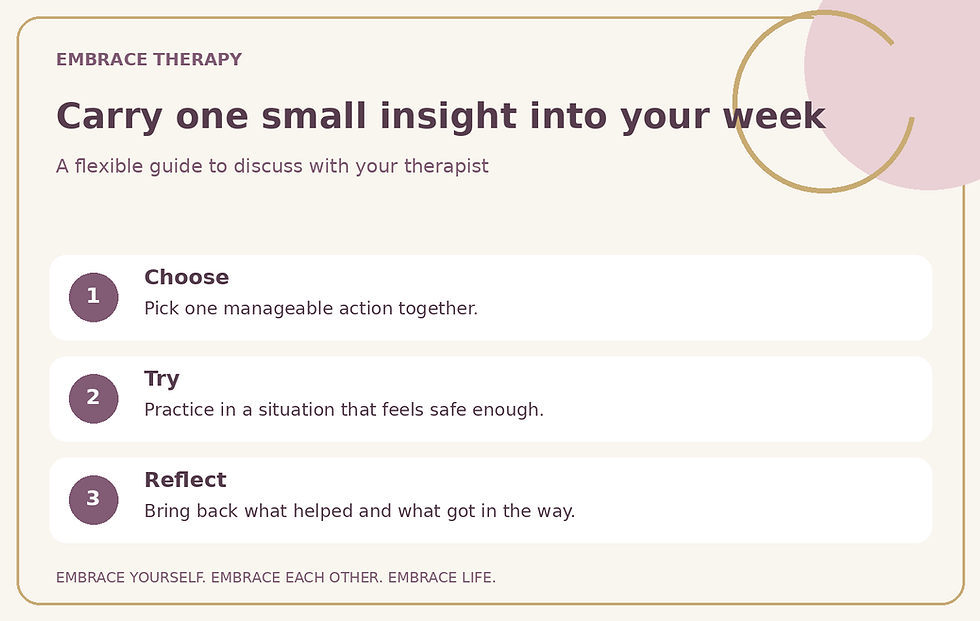
Between sessions, there may be opportunities to try a small change, notice what happens, and bring that experience back to your therapist. What you try should fit your goals, your circumstances, and the kind of therapy you're doing.
Choose something you can actually try this week
“Be more confident” sounds good, but it doesn't offer much guidance when you're put on the spot. A smaller step gives you somewhere to begin.
You might practice saying, “I need a moment to think before I answer.” You might notice one self-critical thought and try a more balanced response. Or you might ask your spouse, “Would you like me to listen, or help you think it through?” before offering advice.
Work out the next step with your therapist. Some approaches use structured practice between sessions; others focus on different parts of the process. You can ask, “What would be useful for me to pay attention to this week?”
Let the plan fit the life you have
If an exercise requires an uninterrupted hour you never get, it's worth adjusting the plan. One sentence in one conversation may be a much more useful place to start.
Your energy, health, responsibilities, and available support all matter. A manageable experiment gives you a chance to learn without turning therapy into another thing you feel behind on.
When it doesn't happen, bring that in too
Maybe you planned to express a preference and stayed quiet. Before deciding you failed, ask what happened. Did you forget? Feel worried about disappointing someone? Struggle to find the words? Feel unsafe?
Each answer points toward a different kind of support. You may need a reminder, a chance to practice aloud, or a conversation about fear and safety. That information is useful to your therapist.
You can arrive and say, “I understood what we talked about, but I couldn't do it in the moment.” That's a valuable place to begin the next session.

Look for changes in ordinary moments
Progress can show up quietly. You catch a reaction a little sooner. Ask for help more clearly. Recover more easily after a difficult conversation. Notice a need you used to brush aside.
Talk with your therapist about what progress means for your goals and how you'll assess it. The National Institute of Mental Health recommends discussing treatment goals, how improvement will be measured, and what to do if things aren't improving.
Small changes deserve attention, and ongoing distress deserves attention too. If you're feeling worse, aren't improving, or don't understand the plan, bring it up. Your therapist can help you think through adjustments or other support.
Give yourself a simple way to remember
If it helps, take a minute after a session to write down one thing you'd like to carry into the week. It might be, “I can ask for time before answering,” or, “I want to talk more about why that felt so hard.” Keep the note somewhere private.
You don't have to journal if it doesn't help. If reflecting alone leaves you overwhelmed or stuck, tell your therapist so you can find another approach. Intensive exercises, including trauma processing, should be guided by your treatment plan rather than a general blog suggestion.
Bring your real week back to the room
You don't need a polished report. Bring the awkward conversation, the moment you surprised yourself, the suggestion that didn't fit, and the thing you still don't understand.
Therapy can make more room for the life you're actually living when you can talk honestly about it. If you're considering support, Embrace works with individuals and couples navigating relational and sexual concerns. You're welcome to reach out and tell us what you're hoping for.
Keep exploring
Looking for a place to practice? You might work with your therapist on handling conflict in marriage or expressing a healthy boundary. Choose a step that fits the work you're doing together.
If you're considering support, explore our therapy services and meet the Embrace team. Our therapy FAQs answer common questions about sessions.
Comments